
Forcing property appreciation is not home improvement; it’s a financial operation where renovations, tax strategies, and financing are weapons to manufacture equity on your own timeline.
- Strategic renovations target appraisal value, not aesthetics, focusing on high-ROI projects like bathrooms and kitchens.
- Advanced tactics like cost segregation and “Subject-To” financing create capital from tax savings and reduced holding costs, fueling portfolio growth.
Recommendation: Stop speculating on market-driven appreciation and start implementing these aggressive strategies to control your investment outcomes and build wealth faster.
Most investors play a waiting game. They buy a property and hope, pray, and wait for the market to lift their asset’s value. This passive approach is a gamble, leaving your returns to chance and the whims of the economy. They might talk about superficial upgrades like painting a door or planting flowers, believing this is how value is created. They are fundamentally wrong. This isn’t about making a home “nicer”; it’s about making it more valuable on a spreadsheet and in an appraiser’s report.
The real players, the investors who build portfolios at speed, don’t wait for appreciation. They manufacture it. They treat real estate not as a home, but as a financial instrument to be manipulated. But if the secret isn’t just about renovating a kitchen or adding a deck, what is it? The key is understanding that forcing appreciation is a calculated, multi-faceted operation. It’s about combining targeted, high-ROI renovations with sophisticated tax strategies and creative financing to engineer a specific financial outcome.
This guide dismantles the passive investor mindset. We will dissect the financial mechanics behind forcing value, moving beyond simple aesthetics to the core of wealth creation. We will analyze which renovations actually move the needle on an appraisal, how to avoid value-destroying mistakes, and how to use inflation, depreciation, and financing as offensive tools to build equity on your command, not the market’s.
This article provides a blueprint for investors ready to shift from passive hope to active wealth creation. Below is a summary of the core strategies we will dissect to empower you to force appreciation in your own portfolio.
Summary: How to Force Appreciation: Increasing Property Value by 20% Through Strategic Renovations?
- Kitchens vs. Bathrooms: Which Renovation Yields the Highest Return on Appraisal?
- How to Avoid “Over-Improving” a Property Beyond What the Neighborhood Can Support?
- Why Does High Inflation Benefit Leveraged Real Estate Holders More Than Cash Savers?
- The Appreciation Fallacy: Why Buying a Negative Cash Flow Property for Future Value Is Gambling?
- When to Sell: Recognizing the Signs of a Market Top Before Prices Stagnate?
- Cost Segregation Study: How to Accelerate Depreciation to lower This Year’s Tax Bill?
- Land Improvements: Why Your Parking Lot Depreciates Faster Than Your Building?
- How to Acquire Real Estate Using “Subject-To” Financing When Interest Rates Are High?
Kitchens vs. Bathrooms: Which Renovation Yields the Highest Return on Appraisal?
Forget your personal taste. The kitchen vs. bathroom debate is not about aesthetics; it’s a cold calculation of Return on Investment (ROI). The goal isn’t to build your dream kitchen, but to install the kitchen or bathroom that an appraiser values most relative to its cost. This is the essence of “appraisal hacking”—making changes specifically designed to maximize the assessed value. While a major kitchen remodel often feels like the heart of a home, it’s frequently a high-cost project with a lower percentage return.
The data points towards bathrooms for surgical, high-impact returns. A midrange bathroom remodel is a safe bet, with data showing that over 73.7% of the cost is recouped at sale, according to the 2024 Cost vs. Value Report. Why? The cost is more contained, and the impact on a home’s functionality is immediate and obvious. A dated bathroom is a major functional flaw, while a slightly dated kitchen can often be overlooked if it’s clean and functional. The key is to identify the property’s “anchor flaw”—the single most outdated space holding back its value. Fixing that often provides a disproportionate lift to the entire property’s perceived value.
Ultimately, the decision rests on a strategic framework, not a gut feeling. You must analyze your specific property, market, and budget to determine where your capital will work hardest. Cosmetic updates (paint, hardware, fixtures) almost always yield a higher percentage return than full gut renovations, which are prone to cost overruns and diminishing returns.
Action Plan: The Strategic Renovation Decision Framework
- Identify the Anchor Flaw: Pinpoint the single biggest issue (e.g., a 1970s bathroom) that is dragging down the property’s entire value perception.
- Analyze Market Comps: Research what level of finish (e.g., granite vs. quartz, stainless vs. paneled appliances) is standard for properties at the top of your neighborhood’s price range. Do not exceed this.
- Calculate ROI, Not Aesthetics: Prioritize projects based on their “Cost per Point of Appraiser Influence.” A $5,000 bathroom refresh that adds $10,000 in value is superior to a $50,000 kitchen that adds $30,000.
- Phase Your Attack: Execute Phase 1 cosmetic updates (paint, fixtures, flooring) first. These often yield over 100% ROI and may be all you need to hit your target valuation.
- Make the Go/No-Go Decision: Select the renovation tier based strictly on projected ROI and alignment with market comps, not your personal dream home checklist.
How to Avoid “Over-Improving” a Property Beyond What the Neighborhood Can Support?
The single most common way amateur investors destroy capital is through over-improvement. Installing Italian marble countertops and Viking appliances in a neighborhood of laminate and Kenmore is financial suicide. Every neighborhood has a “ceiling price,” a value beyond which buyers will not go, regardless of your property’s finishes. Your job is to renovate *up to* that ceiling, but never through it. Pushing past this limit means every dollar you spend is a sunk cost with zero return.
The strategy is to make your property the best on the block, but still recognizably on that block. You must conduct ruthless comparable sales analysis (comps). Identify the three most expensive recently sold homes within a half-mile radius that are similar in size and style. These sales define your ceiling. Your goal is to match their level of finish, not exceed it. If the top comps have granite, you install granite. If they have high-end laminate, you do the same. This isn’t about being cheap; it’s about being profitable.
Case Study: Austin Market Renovation Value Analysis
In the competitive Austin market, this principle is critical. A minor remodel of around $20,000 can increase a home’s value by $12,000 to $16,000, achieving a 60-80% ROI. However, a major remodel costing $50,000+ might only add $30,000 to $40,000 in value. This demonstrates diminishing returns. The profit is in the smaller, targeted renovations that align with the expectations in specific neighborhoods like Hyde Park or Tarrytown, not in building a palace that the local market cannot support financially.
This image illustrates the concept perfectly: your property must fit harmoniously within its environment. Being the glaringly overbuilt house is a sign of an amateur who let ego drive investment decisions. The smart investor’s property blends in at the top of the range, making it the easy and obvious choice for a buyer in that specific market segment.
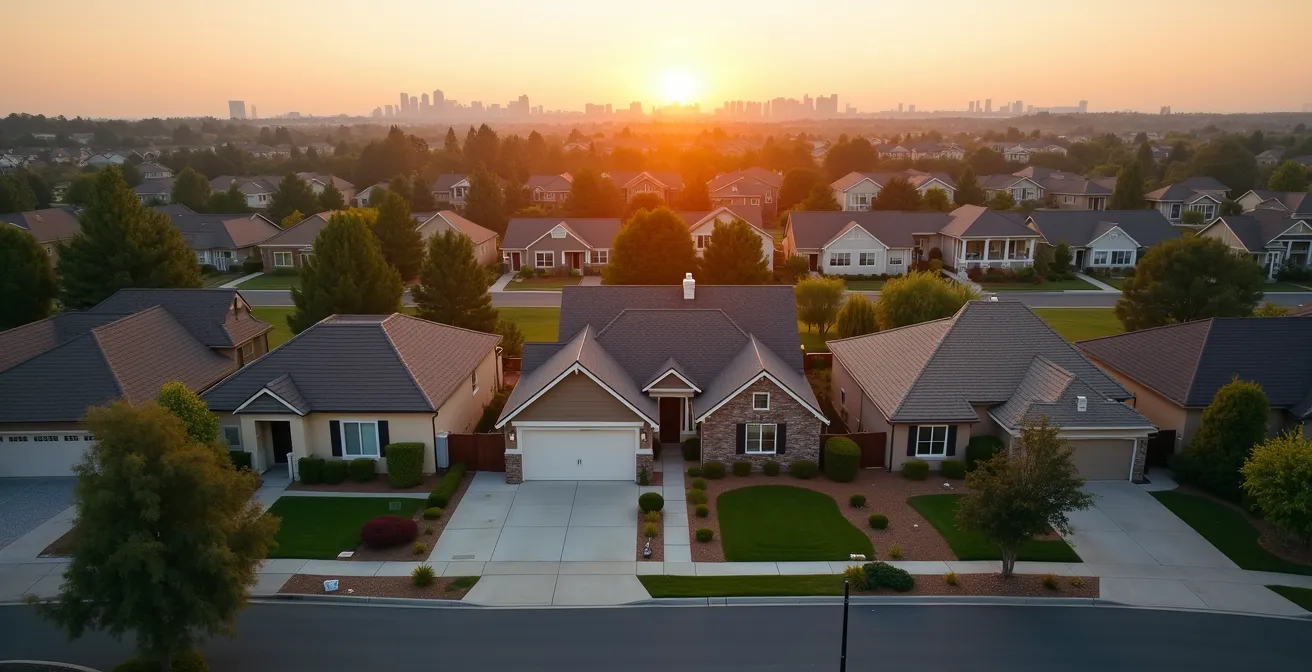
Look at the gradient of homes. Your goal is to move your property from a mid-tier position to the top of its immediate cluster, not to try and compete with a property two tiers above it in a different part of the city. The profit lies in a precise, market-aligned transformation.
Why Does High Inflation Benefit Leveraged Real Estate Holders More Than Cash Savers?
Inflation is a hidden wealth-transfer mechanism that punishes savers and massively rewards those holding leveraged assets, especially real estate with fixed-rate debt. While the person holding cash in a savings account sees their purchasing power erode every day, the leveraged real estate investor benefits from a powerful two-pronged attack: their asset value inflates, and their debt deflates.
The core concept is debt erosion. You borrowed money in today’s strong dollars, and you are paying it back over 30 years with tomorrow’s weaker, inflation-eaten dollars. Your largest liability—the mortgage—is fixed, but your largest asset—the property—and the income it generates—the rent—are variable and rise with inflation. Every time the consumer price index ticks up, the real value of your debt ticks down. Over time, this effect is massive. For a saver, inflation is a tax; for a leveraged investor, it’s a subsidy.
Case Study: Inflation-Driven Property Value Growth
Consider an investor who bought a property for $500,000 in 2010. Assuming a modest 2% annual inflation rate, the real value of their fixed mortgage payment shrinks each year. Meanwhile, while your property’s value inflates, your debt is eroded by a cumulative inflation effect of 22.09% over a decade. Simply by keeping pace with this minimal inflation, the property’s value would rise to over $610,000. The investor’s asset grew by over $110,000, while the real cost of their debt simultaneously decreased. This is wealth creation through financial mechanics, not active management.
This is why holding significant cash is one of the riskiest financial positions during inflationary periods. The cash holder is guaranteed to lose purchasing power. The leveraged real estate holder, by contrast, has a powerful, inflation-proof engine. Their rents can be adjusted upwards to match inflation, increasing cash flow, while the principal and interest payment on their loan remains static. This widening gap between income and fixed expenses is pure profit, created out of thin air by macroeconomic forces.
The Appreciation Fallacy: Why Buying a Negative Cash Flow Property for Future Value Is Gambling?
Speculating on market appreciation is not investing; it’s gambling. Buying a property that loses money every month (negative cash flow) under the hope that “the market will go up” is a recipe for disaster. This strategy makes you a hostage to macroeconomic trends you cannot control. A market downturn, a rise in interest rates, or a local job market collapse can wipe you out. A true investor manufactures their own appreciation. The profit is made on the buy and through the renovation, not on the hope of a future sale.
Forced appreciation, by contrast, is a calculated business operation. You purchase an underperforming asset, execute a strategic renovation plan to increase its value and rental income, and then refinance to pull your capital out. The math is simple: After-Repair Value (ARV) must significantly exceed your Total Project Cost (Purchase Price + Renovation Costs + Holding Costs). This “forced” equity is your profit, created through your actions, not market luck. It’s the foundation of the BRRRR (Buy, Rehab, Rent, Refinance, Repeat) strategy.
This timeline shows the investor’s journey: an initial period of intense capital outlay and negative cash flow during the renovation is a planned-for cost of business. It’s a short-term investment to engineer a long-term step-change in value and cash flow.

Unlike the speculator who bleeds cash indefinitely, the strategic investor has a clear timeline and budget to transition from negative to positive. The goal is to get the property stabilized and appraised at its higher value as quickly as possible, turning it from a capital drain into a cash-flowing asset. This control over the outcome is the fundamental difference between professional investing and amateur speculation.
When to Sell: Recognizing the Signs of a Market Top Before Prices Stagnate?
Timing the market is a fool’s errand, but recognizing signs of a top in your *micro-market* is a critical skill for maximizing returns. Forget national news headlines and Federal Reserve speculation. The most potent signals are hyper-local. As a value-add investor, your exit can be a sale or a refinance. Both depend on a high appraisal, which is influenced by market velocity. When the market cools, appraisal values get conservative. You must be able to read the tea leaves to exit at maximum valuation before the easy money is gone.
The key is to track a handful of specific, on-the-ground metrics for your exact property type and neighborhood. One of the most powerful is Renovated Inventory Saturation. If the number of freshly renovated homes for sale in your zip code suddenly doubles in 60 days, you’re not a genius anymore; you’re just one of the herd. This flood of new supply means more competition, longer days on market, and downward pressure on prices. It’s a massive red flag signaling that the window of opportunity is closing.
Shift focus from macro indicators to micro-market metrics. If the number of renovated homes for sale in your specific neighborhood doubles in 60 days, that’s a more critical sell signal than a national interest rate hike.
– TC Management Property Analysts, in their How to Raise Property Value Report 2025
This table outlines the critical micro-signals you should be tracking relentlessly. When multiple indicators flip from “Hold” to “Sell” territory, it’s not a time to get greedy. It’s time to execute your exit strategy—sell the property or complete your cash-out refinance—before the market turns against you.
| Indicator Type | Sell Signal | Hold Signal | Action Threshold |
|---|---|---|---|
| Renovated Inventory Saturation | Doubles in 60 days | Steady or decreasing | Monitor weekly MLS listings |
| 90-Day Absorption Rate | Increases beyond 120 days | Stays under 90 days | Track monthly for your property type |
| Return on Equity (ROE) | Falls below 5% annually | Maintains 15%+ annually | Calculate quarterly |
| Days on Market (comparable properties) | Increases 30%+ vs prior year | Stable or decreasing | Review comparable sales monthly |
| Price Reductions Frequency | 40%+ of listings reducing price | Under 20% reducing | Monitor neighborhood trends |
Cost Segregation Study: How to Accelerate Depreciation to lower This Year’s Tax Bill?
Depreciation is one of the most powerful wealth-building tools in real estate, yet most investors only scratch the surface. By default, the IRS allows you to depreciate a residential building’s value over 27.5 years. But the building isn’t a single object; it’s a collection of components, many of which have a much shorter useful life. This is where a cost segregation study becomes a financial weapon.
A cost segregation study is an engineering-based analysis that identifies and reclassifies property components into shorter depreciation schedules. Things like carpeting, fixtures, specific plumbing, and cabinetry are not part of the building’s structure (27.5-year property); they are personal property (5 or 7-year) or land improvements (15-year). By re-categorizing these assets, you can dramatically accelerate your depreciation deductions into the first few years of ownership. This isn’t a loophole; it’s a sophisticated application of the tax code.
The financial impact is immediate and profound. These massive, front-loaded deductions can create a significant “paper loss,” drastically reducing or even eliminating your current income tax liability. This generates a substantial tax refund that can be redeployed immediately. For a flipper or BRRRR investor, this is rocket fuel. For example, expert analysis shows that re-categorizing $50,000 of a $75,000 kitchen renovation as personal property can generate Year 1 tax savings of about $15,000, depending on your tax bracket.
Case Study: The Renovation Tax-Savings Loop
An investor uses a cost segregation study on $50,000 of renovation costs, shifting their depreciation from a 27.5-year schedule to a 5-year schedule. This move generates a large tax refund in the first year. Instead of spending it, the investor uses that exact refund as the down payment for their next forced-appreciation project. This creates a self-perpetuating capital engine, where the tax savings from one deal directly fund the acquisition of the next, dramatically increasing the investor’s capital velocity and portfolio growth rate.
Land Improvements: Why Your Parking Lot Depreciates Faster Than Your Building?
Most investors focus their depreciation efforts inside the four walls of the building. This is a mistake. The IRS makes a critical distinction between the building itself (27.5-year residential / 39-year commercial) and “land improvements.” These are assets outside the building but on the property, and they have a much faster 15-year depreciation schedule. This is another form of “Depreciation Arbitrage” that aggressive investors exploit.
What qualifies as a land improvement? The list is extensive: paving for parking lots and driveways, fencing, landscaping, sidewalks, and outdoor lighting systems. For a commercial or multifamily property, the value of these assets can be substantial. A cost segregation study will break out the cost of these components, allowing you to depreciate them nearly twice as fast as the building’s structural shell. This, again, front-loads your tax deductions, reduces your current tax bill, and boosts your cash flow.
The strategy is to “stack” these improvements. When renovating a property, you’re not just thinking about the interior ROI. You are also analyzing the tax benefits of exterior work. Adding a new fence for privacy, repaving a cracked driveway, or installing an outdoor lighting system for security aren’t just “curb appeal” expenses; they are tax-advantaged investments. Each one can be added to the 15-year depreciation schedule, creating a powerful cumulative deduction. While these additions can certainly add to the property’s value from an appraisal standpoint, their primary benefit is often found in the immediate tax savings they generate.
This is a perfect example of thinking like a developer. Every dollar spent must be evaluated on its dual impact: its contribution to the After-Repair Value (ARV) and its ability to be manipulated for maximum tax advantage. The parking lot becomes more than a place for cars; it becomes a tool for generating immediate investment capital through tax deferral.
Key Takeaways
- Forcing appreciation is an active financial strategy, not passive home improvement.
- Leverage tax laws like cost segregation to turn depreciation into immediate, reinvestable capital.
- Master creative financing like “Subject-To” to control assets with less capital and lower holding costs, maximizing renovation budgets.
How to Acquire Real Estate Using “Subject-To” Financing When Interest Rates Are High?
In a high-interest-rate environment, traditional financing becomes a ball and chain. High monthly payments crush cash flow and eat into your renovation budget, slowing your capital velocity to a crawl. “Subject-To” financing is a powerful counter-maneuver. It’s a creative acquisition strategy where you take title to a property “subject to” the existing mortgage. You don’t formally assume the loan; you simply take over the seller’s payments.
Why is this so powerful? Imagine it’s today and rates are 7%. You find a seller who bought or refinanced two years ago and has a 3% mortgage. By taking over their loan, you acquire the property with a financing cost that is less than half of the current market rate. This isn’t just a small savings; it’s a monumental strategic advantage. The difference in monthly payment is pure profit that can be funneled directly into your renovation budget, allowing you to force appreciation faster and with less of your own capital.
Case Study: The “Subject-To” Plus Rehab Loan Blended Strategy
An investor finds a multifamily property with a motivated seller who has a low-interest 3% mortgage. The investor acquires the property using Subject-To, immediately securing low holding costs. Then, they obtain a separate, short-term hard money or private loan *only* for the $50,000 renovation. By blending these two financing instruments, the investor’s blended cost of capital is far lower than a new 7% commercial loan for the entire purchase and rehab. This allows them to execute cosmetic updates and modernize kitchens, forcing appreciation of 20% within 24 months while competitors are sidelined by high interest rates.
This table quantifies the overwhelming advantage. The savings on holding costs are not just “extra cash”; they are the fuel for the renovation that manufactures your equity. While others are paying the bank, you are paying your contractors, directly increasing your asset’s value.
| Financing Aspect | Traditional 7% Loan | Subject-To 3% Loan | Monthly Savings |
|---|---|---|---|
| $300k Property Monthly Payment | $1,996 | $1,265 | $731 |
| Annual Holding Costs | $23,952 | $15,180 | $8,772 |
| Available for Renovation (3 years) | $0 | $26,316 | $26,316 |
| Total Project Cost (with $50k reno) | $350,000 | $323,684 | $26,316 saved |
| Break-even Timeline | 5-7 years | 3-4 years | 2-3 years faster |
The market doesn’t dictate your returns; your strategy does. The tools and tactics outlined here—from appraisal hacking and depreciation arbitrage to creative financing—are the components of a machine designed to manufacture equity. The question is no longer ‘if’ you can force appreciation, but ‘how quickly’. Stop waiting for the market to give you permission and start engineering your own financial success.