
The most dangerous mistake a landlord can make is confusing rental income with personal profit. Without a structured reserve system, a single major repair can wipe out years of gains.
- Instead of using generic percentages, calculate reserves based on the specific age and condition of your property’s major systems (roof, HVAC, etc.).
- Classify every expense using the IRS’s BAR Test (Betterment, Adaptation, Restoration) to legally optimize your tax deductions versus capital improvements.
Recommendation: Immediately shift from a reactive “emergency fund” mindset to a proactive, data-driven operational discipline. Treat your capital reserve as a non-negotiable operating expense, just like a mortgage payment.
For many small landlords, the monthly rent check feels like pure profit. After the mortgage, taxes, and insurance are paid, the remainder is seen as disposable income. This is a critical and often catastrophic financial error. A rental property is not an ATM; it is a complex business with aging assets. Treating it as anything less is a direct path to financial distress. When a $10,000 roof replacement or a surprise HVAC failure occurs, the landlord without a disciplined reserve strategy is forced to liquidate other investments, take on high-interest debt, or worse, sell the asset at a loss.
The standard advice—to save a vague percentage of the property’s value—is insufficient. It fails to account for the specific realities of your building. A new construction has a different risk profile than a 20-year-old property with its original systems. True financial resilience doesn’t come from a simple savings account; it comes from adopting the mindset of a Chief Financial Officer for your own portfolio. This requires a shift from reactive saving to proactive, predictive forecasting.
This guide abandons generic rules of thumb. Instead, we will build a systematic framework for calculating, funding, and deploying capital reserves. You will learn how to precisely estimate the lifespan of your critical systems, structure contracts to mitigate risk, and make strategic tax decisions that distinguish professional operators from amateurs. The goal is to transform your capital reserve from a source of anxiety into a powerful tool for operational stability and long-term wealth creation. We will establish the operational discipline that ensures a major repair remains a planned business expense, not a personal financial crisis.
This article provides a structured approach to mastering your capital expenditures. Below is a summary of the key areas we will cover to build your financial fortress.
Summary: A Disciplined Approach to Capital Reserves
- Roof, HVAC, and Water Heater: How to Predict Exactly When Your Big Systems Will Fail?
- The Compound Cost of Neglect: Why Saving $500 Now Will Cost You $5,000 Later?
- Quarterly vs. Bi-Annual Inspections: Which Frequency Balances Oversight with Tenant Privacy?
- Fixed Bid vs. Time and Materials: Which Contract Structure Protects You During Major Repairs?
- The Emergency Protocol: How to Handle a 3 AM Pipe Burst Without Overpaying for Service?
- Why Do Real Estate Investors Need 6 Months of Liquid Reserves Per Door?
- The BAR Test: Is Your Roof Repair a Restoration, Betterment, or Adaptation?
- Capitalize vs. Expense: How to Determine Which Repairs Are Deductible This Year?
Roof, HVAC, and Water Heater: How to Predict Exactly When Your Big Systems Will Fail?
Predicting major system failure is the cornerstone of a prudent capital reserve strategy. It requires moving beyond guesswork and implementing a data-driven forecasting model. The first step is to understand the typical lifespan of your assets. For example, most modern HVAC systems typically last between 15 to 25 years, while a standard asphalt shingle roof may last 20-30 years. These figures, however, are merely a starting point. Your specific property requires a more granular analysis.
To achieve true predictability, you must create a “System Health Score” for each major component. This is not a complex accounting exercise but a disciplined evaluation. It involves assigning a weighted score based on critical factors to create a clear, actionable metric. This data-driven approach is further enhanced by modern technology, allowing for precise monitoring.
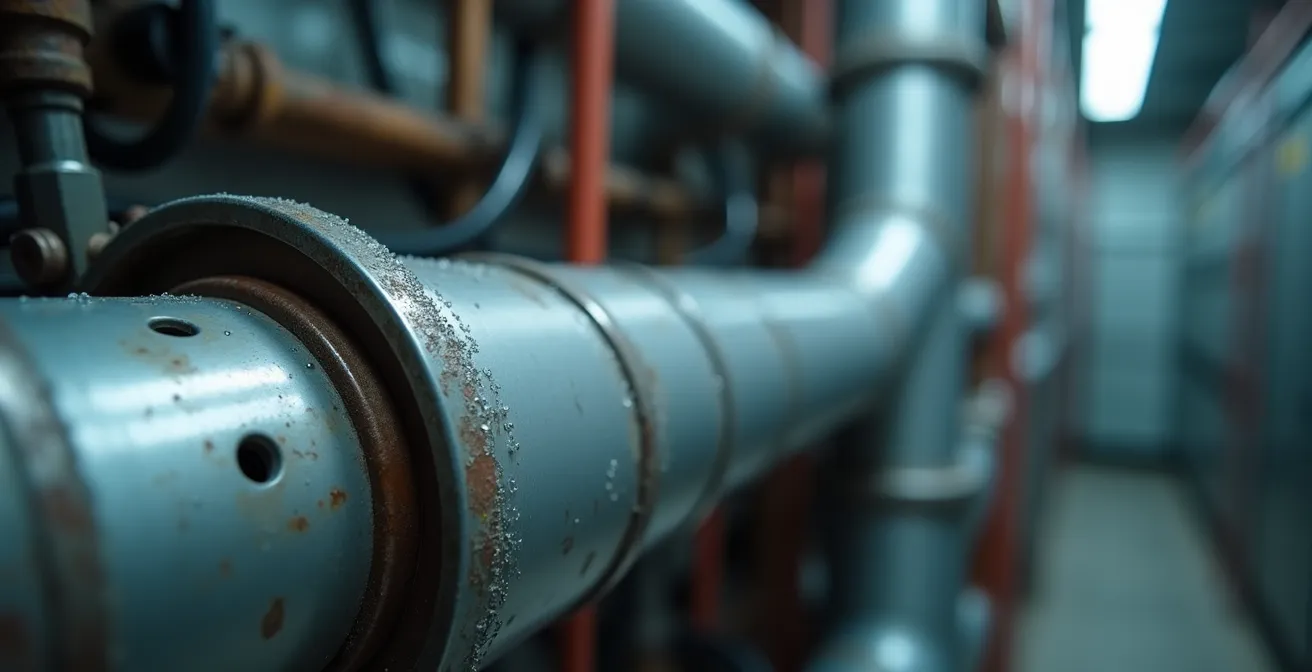
As shown, tools like IoT sensors provide real-time data on system performance, but a manual, systematic assessment is equally powerful. A rigorous scoring method transforms abstract risk into a quantifiable forecast, allowing you to fund your reserves with precision. The process involves these key steps:
- Evaluate the remaining useful life based on manufacturer specifications and industry standards.
- Assess installation quality by examining ductwork, flashing, and connection points for signs of poor workmanship.
- Monitor usage intensity through runtime hours and cycling frequency, if possible.
- Document inspection findings including corrosion, wear patterns, and efficiency degradation.
- Assign a score from 1-10 based on weighted factors: age (40%), condition (30%), maintenance history (20%), and usage patterns (10%).
This systematic scoring allows you to move from a vague “emergency fund” to a predictable, line-item budget for future replacements. It is the first and most critical step in building genuine financial resilience for your real estate investment.
The Compound Cost of Neglect: Why Saving $500 Now Will Cost You $5,000 Later?
Financial discipline in property management is not about saving money; it is about avoiding the amplified costs of procrastination. Deferring a small, preventative repair today almost guarantees a significantly larger, more complex, and more expensive emergency tomorrow. This is the compound cost of neglect, a principle that financially ruins unprepared landlords. A dripping faucet that could be fixed for $200 can lead to a $5,000 bill for mold remediation and subfloor replacement if ignored.
This isn’t theoretical. As property management experts document, major systems rarely fail at convenient times. A water heater is far more likely to burst on a holiday weekend when your property is full and emergency service rates are at their peak. These scenarios aren’t just costly; they damage tenant relationships, risk negative reviews, and create immense personal stress. The “savings” from skipping a routine HVAC tune-up evaporate when the system fails during a heatwave, forcing you to pay exorbitant rush fees for an emergency replacement.
The financial impact extends beyond the immediate repair bill. When you lack dedicated reserves, these emergency costs must be paid from your net operating income (NOI). A significant, unplanned expense can easily result in negative cash flow for the entire year, eroding your investment returns. In a worst-case scenario, the bill is so large that it triggers a “capital call,” forcing you to inject personal funds or take on unfavorable debt just to keep the property solvent. The $500 you “saved” by deferring maintenance has now become a multi-thousand-dollar threat to your entire investment. This is why a fully-funded reserve is not an option; it is a core component of a profitable real estate operation.
Quarterly vs. Bi-Annual Inspections: Which Frequency Balances Oversight with Tenant Privacy?
A systematic inspection schedule is the primary data-gathering tool for your predictive reserve model. However, the optimal frequency is not one-size-fits-all; it depends on the age and complexity of your property. The goal is to strike a professional balance between diligent oversight and respect for tenant privacy. Over-inspecting can be intrusive, while under-inspecting leads directly to the compound cost of neglect. A tiered framework is the most prudent approach.
This tiered strategy allows you to allocate your attention where it’s most needed, maximizing risk mitigation while minimizing tenant disruption. For all inspections, providing a professional 48-hour notice that frames the visit as a “preventive care service” or “seasonal system check-up” fosters cooperation and reinforces your role as a responsible manager. This proactive communication is key. As noted by industry leaders, this structured approach is about prevention. According to the experts at ABM Facility Services in their Commercial HVAC Maintenance Guidelines:
Schedule routine maintenance (quarterly or at the start of each heating/cooling season)… Working with a qualified HVAC partner can help you catch small problems before they become big expenses.
– ABM Facility Services, Commercial HVAC Maintenance Guidelines
A structured inspection schedule, tailored to your property’s lifecycle, is a non-negotiable component of professional asset management. Here is a logical framework to implement:
- New Properties (0-5 years): Bi-annual comprehensive inspections are sufficient. The focus should be on ensuring systems are operating per specification and identifying any potential warranty claims before they expire.
- Mid-Age Properties (5-15 years): Increase frequency. Conduct quarterly checks of mechanical rooms (HVAC, water heaters) and bi-annual inspections of the full property, including roofs and attics.
- Aging Properties (15+ years): These require the most oversight. Implement quarterly targeted inspections of critical systems that are approaching their expected end-of-life to catch the earliest signs of failure.
For every inspection, regardless of frequency, you must document findings with timestamped photos. This creates an invaluable log for maintenance tracking, future budget forecasting, and supporting any potential insurance claims. It is the hallmark of a disciplined operator.
Fixed Bid vs. Time and Materials: Which Contract Structure Protects You During Major Repairs?
Once your predictive model identifies a forthcoming major repair, the next phase of financial discipline is execution. The type of contract you sign with a vendor is not merely a formality; it is a strategic tool for allocating financial risk. Choosing the wrong structure can expose you to significant cost overruns and disputes. The two most common types are Fixed Bid and Time & Materials (T&M), each with distinct risk profiles.
A Fixed Bid contract locks in the price upfront. This provides high cost certainty, making it ideal for projects with a clearly defined scope, such as a straightforward roof replacement. In this model, the contractor bears the risk of cost overruns. However, its rigidity means that any change to the scope (a “change order”) can be expensive. In contrast, a Time & Materials contract is flexible. You pay for the actual hours worked and materials used. This is suitable for emergency repairs or projects where the full scope is unknown, such as diagnosing a mysterious leak. The flexibility is a benefit, but it places the risk of cost overruns squarely on you, the owner.

The key to selecting the right contract is the quality of your project’s scope of work. A well-defined scope, as pictured above, allows for accurate fixed bids and protects you from ambiguity. For more complex projects, a hybrid model like a Guaranteed Maximum Price (GMP) contract can offer a ceiling on costs while still providing some flexibility. Understanding these structures allows you to align the contract with the project’s specific risks.
The following table breaks down the risk-benefit analysis for each primary contract type, providing a clear guide for your decision-making process.
| Contract Type | Cost Certainty | Flexibility | Best Use Case | Risk Profile |
|---|---|---|---|---|
| Fixed Bid | High – price locked in advance | Low – change orders costly | Well-defined scope, routine replacements | Contractor bears cost overrun risk |
| Time & Materials | Low – final cost variable | High – scope can evolve | Emergency repairs, discovery work | Owner bears cost overrun risk |
| Guaranteed Maximum Price (GMP) | Medium – ceiling with flexibility | Medium – managed change orders | Complex projects with unknowns | Shared risk model |
| Preferred Vendor Agreement | Pre-negotiated rates | High – immediate response | Ongoing maintenance, emergencies | Predictable pricing, priority service |
The Emergency Protocol: How to Handle a 3 AM Pipe Burst Without Overpaying for Service?
Even with the most disciplined forecasting, emergencies happen. A pipe can burst at 3 AM, or a storm can cause unexpected damage. The difference between a controlled response and a financial catastrophe lies in having a pre-defined emergency protocol. Panicked, middle-of-the-night decisions are almost always expensive ones. Your goal is to make the critical decisions now, in a calm and rational state, so that when an emergency strikes, you are simply executing a plan.
A key component of this plan is establishing a relationship with a pre-vetted 24/7 vendor and negotiating emergency rates in advance. This single step can save you thousands compared to scrambling for a provider during a crisis. The core of your protocol should be a physical or digital “Emergency Response Binder” that contains all critical information in one accessible location. This is not just a contact list; it is a comprehensive operational playbook.
The financial stakes of being unprepared are enormous. A major event like water damage can decimate your cash flow if the repair cost must be funded from your regular operating income. A well-funded reserve and an efficient emergency protocol ensure that you can authorize immediate mitigation efforts, which is often the most critical factor in controlling the total cost of the incident. Speed and preparation are your greatest financial allies in a crisis.
Your Emergency Protocol Checklist
- Compile a pre-vetted 24/7 vendor contact list with pre-negotiated emergency rates for plumbing, electrical, and restoration services.
- Keep insurance policy numbers and the direct contact line for the claims department readily available.
- Photograph the locations of all shut-off valves (water, gas) and electrical panels, and store them in the binder for quick reference by you or a vendor.
- Document property access instructions, including lockbox codes, alarm procedures, and any specific notes for entry.
- Maintain a current list of tenant emergency contact information and their preferred notification methods (call, text, email).
This binder transforms a high-stress event into a manageable, step-by-step process. It empowers you or a designated representative to act decisively, mitigate damage, and control costs, even in the most challenging circumstances.
Why Do Real Estate Investors Need 6 Months of Liquid Reserves Per Door?
The “six months of reserves” rule is a common benchmark in real estate, but as a disciplined operator, you must understand its underlying logic and limitations. This rule generally refers to holding six months’ worth of total expenses (mortgage, taxes, insurance, utilities) in a liquid account. For a property with $2,000 in monthly expenses, this would mean $12,000 in reserves. This serves as a crucial buffer against vacancies and unforeseen repairs, and it’s a standard that lenders often look for.
Indeed, when underwriting a property, banks typically require evidence of capital reserves, often mandating contributions of $0.25 to $0.50 per square foot annually for older buildings. This external requirement underscores the non-negotiable importance of liquidity. However, the “per door” application of this rule can be debated as a portfolio grows. While you certainly need $12,000 for your first property, do you need a full $120,000 in liquid cash for ten identical properties?
The argument against a linear scaling of reserves is based on statistical probability. The chances of all ten properties experiencing a major vacancy or a catastrophic failure simultaneously are extremely low. As a portfolio diversifies, the risk is spread out. Therefore, a more sophisticated approach might involve fully funding reserves for the first few properties and then using a more conservative, scaled-down model for subsequent acquisitions. For example, one might hold 100% of required reserves for properties 1-3, 50% for properties 4-6, and 25% for all others, relying on the pooled fund to cover any single event. This strategy frees up capital for further investment while still maintaining a prudent and defensible reserve position.
Ultimately, the “six months” rule is an excellent starting point and an absolute necessity for new investors. It provides a robust safety net. For the growing investor, it evolves into a strategic calculation that balances risk mitigation with capital efficiency. The key is to have a clearly articulated strategy, whether it’s a simple per-door rule or a more complex portfolio-based model.
Key Takeaways
- Shift your mindset from a landlord to a property CFO; treat reserves as a non-negotiable operating expense.
- Base your reserve calculations on the specific age and condition of your systems (the “System Health Score”), not generic percentages.
- Master the IRS’s BAR Test and Safe Harbor rules to make intentional, tax-efficient decisions on every repair and improvement.
The BAR Test: Is Your Roof Repair a Restoration, Betterment, or Adaptation?
After you have prudently funded your reserves and executed a repair, the final act of financial discipline is to correctly classify the expense for tax purposes. This is one of the most powerful—and most frequently misunderstood—levers a landlord has for optimizing their financial position. The IRS provides a specific framework for this: the BAR Test. Every expense must be evaluated to see if it qualifies as a Betterment, Adaptation, or Restoration. If it falls into one of these categories, it is a capital improvement and must be depreciated over time. If not, it’s a repair and can be deducted immediately.
Understanding these classifications is crucial. A Betterment improves the property beyond its original state, such as upgrading from basic shingles to a higher fire-rated material. An Adaptation converts the property to a new or different use, like reinforcing a roof structure to support the installation of solar panels. A Restoration returns a major component to its like-new condition, such as a full roof replacement after years of deterioration. Anything else—like patching a leak or replacing a few damaged shingles—is generally considered a repair.
The challenge arises when work is combined. As noted by tax professionals, great documentation is essential because the IRS requires taxpayers to depreciate all direct and indirect costs associated with an improvement. This means if you perform a deductible repair at the same time as a capital improvement, you must be able to prove, through great documentation like invoices and photos, that the repair was not incurred because of, or did not directly benefit from, the improvement. Without this audit-proof documentation, you risk having the entire project reclassified as a capital expense, losing the immediate deduction.
This table clarifies the definitions and tax treatment according to the BAR Test, providing a guide for proper classification.
| Classification | Definition | Tax Treatment | Examples |
|---|---|---|---|
| Betterment | Improves performance beyond original state | Capitalize & Depreciate | Upgrading to higher fire rating shingles |
| Adaptation | Converts property to new use | Capitalize & Depreciate | Reinforcing roof for solar panels |
| Restoration | Returns property to operating condition | Capitalize & Depreciate | Full roof replacement after deterioration |
| Repair | Maintains current condition | Immediate Deduction | Replacing damaged shingles, patching leaks |
Capitalize vs. Expense: How to Determine Which Repairs Are Deductible This Year?
The decision to capitalize or expense an outlay is a critical annual strategy. While the BAR Test provides the foundational logic, the IRS also offers several “safe harbor” provisions that allow taxpayers to expense certain items that might otherwise need to be capitalized. Leveraging these safe harbors is a hallmark of an informed and tax-efficient operator. Failing to use them is the equivalent of leaving money on the table.
The most common is the De Minimis Safe Harbor. For landlords who have audited financial statements, this allows for the immediate deduction of any item or invoice up to $5,000. For small landlords without such statements, the limit is $2,500 per item per invoice. Another powerful tool is the Routine Maintenance Safe Harbor, which allows expensing of activities that are reasonably expected to be performed more than once during the asset’s class life (e.g., every 3-5 years for a building with a 27.5-year life). Finally, the Small Taxpayer Safe Harbor applies to businesses with less than $10 million in revenue owning buildings with an unadjusted basis of less than $1 million. It allows for the expensing of total annual repairs and maintenance up to the lesser of 2% of the building’s basis or $10,000.
When an expense does not qualify for a safe harbor or is classified as a capital improvement under the BAR Test, it must be depreciated. According to tax regulations, these capital improvements must be depreciated over 27.5 years for residential rental property or 39 years for commercial property. This long depreciation schedule highlights the significant cash flow advantage of classifying an expense as a repair whenever legally possible. Your decision-making framework should be systematic:
- First, see if the expense qualifies under the De Minimis Safe Harbor for an immediate deduction.
- If not, determine if it meets the criteria for the Routine Maintenance Safe Harbor.
- If you qualify, check if the expense fits within the annual limits of the Small Taxpayer Safe Harbor.
- If none of the safe harbors apply, you must then apply the BAR Test to determine if it is a capital improvement or a deductible repair.
This disciplined, sequential process ensures you are making the most tax-advantaged decision for every dollar you spend on your property. It requires meticulous record-keeping but pays substantial dividends by maximizing your current-year deductions.
By implementing these structured financial controls, you transform your role from a passive rent collector into an active asset manager, ensuring the long-term profitability and stability of your investment. Your next step is to begin building your property’s specific System Health Score and formalizing your reserve funding policy today.