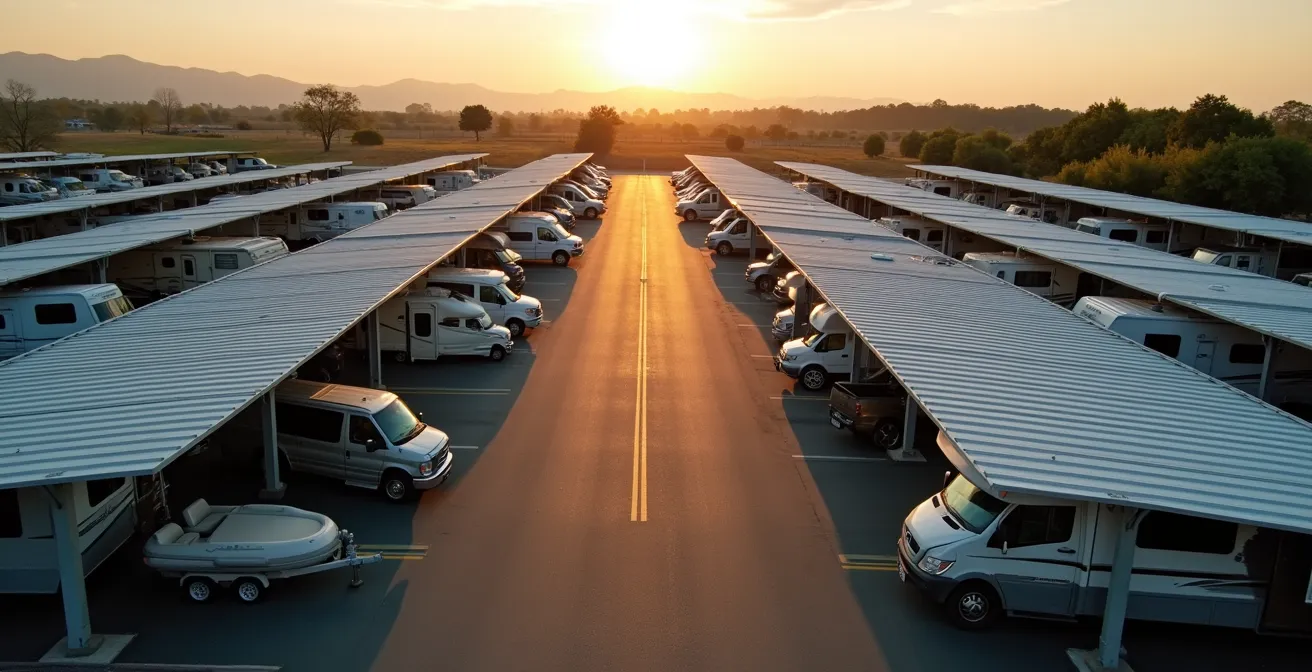
Achieving a 12%+ cash-on-cash return in RV and boat storage is not just possible, but system-driven by exploiting specific market inefficiencies and deploying automated operational models.
- Chronic under-supply, driven by restrictive homeowner association (HOA) rules, creates a permanent, high-demand environment for vehicle storage.
- Modern automation—from gate access to billing—and tiered security offerings allow for near-zero on-site staffing and turn operational necessities into profit centers.
Recommendation: Instead of focusing on land acquisition alone, prioritize data-driven site selection and implementing the 85% occupancy trigger for expansion to maximize yield and create a truly passive investment.
For many investors, real estate represents the ideal asset: tangible, income-producing, and an effective inflation hedge. Yet, the traditional model of residential or commercial properties often comes with the dreaded “tenants and toilets”—a constant stream of maintenance, vacancies, and management headaches. This reality pushes many savvy entrepreneurs to seek alternatives that offer the financial benefits of real estate without the operational drag. The search for high-yield, low-maintenance assets is relentless, leading many to overlook one of the most promising niches in the market.
While some investors are fixated on single-family homes or volatile commercial retail, a quiet revolution is happening on the fringes of suburbia. The common advice is to “buy land” or “diversify,” but these platitudes offer no real strategy. The real opportunity lies not just in owning property, but in solving a specific, growing problem for a high-value customer base. The key isn’t simply to build another storage facility; it’s to create an automated, high-security ecosystem tailored to owners of expensive recreational vehicles and boats who are being squeezed out of their own neighborhoods.
But what if the path to a 12% cash-on-cash return wasn’t about finding the perfect tenant, but about eliminating the need for them altogether? The secret lies in a specific operational playbook—a system of data-driven site selection, automated management, and precise expansion triggers. This isn’t just about passive income; it’s about building a system-driven profitability machine. This guide will break down the exact financial and operational levers you need to pull to turn empty land into a high-yielding cash flow engine, far from the headaches of traditional real estate.
This article provides a detailed roadmap for investors looking to capitalize on this niche. We will explore the key market drivers, site selection strategies, operational models, and financial triggers that define success in the RV and boat storage industry.
Summary: A Strategic Guide to RV and Boat Storage Investment
- Why Are RV Sales Booming While Storage Capacity Lags Behind by 30%?
- How to Identify High-Demand Zones for Vehicle Storage Using Traffic and Zoning Data?
- The Security Protocol That Prevents Catalytic Converter Theft in Remote Storage Lots
- Gate Systems and Billing: How to Run a 200-Unit Facility with Zero On-Site Staff?
- When to Add More Units: Recognizing the 85% Occupancy Trigger for Expansion
- Warehouses vs. Strip Malls: Why E-commerce Is Making One a Winner and the Other a Risk?
- Why Does Residential Real Estate Often Outperform Cash During High Inflation Periods?
- How to Diversify Your Real Estate Portfolio Beyond Single-Family Homes for Better Yields?
Why Are RV Sales Booming While Storage Capacity Lags Behind by 30%?
The foundation of the 12% return model in RV and boat storage is built on a fundamental economic imbalance: soaring demand meeting severely constrained supply. The pandemic accelerated a cultural shift towards domestic travel and outdoor recreation, causing a surge in RV and boat sales. However, the more powerful and permanent driver of storage demand is the proliferation of Homeowner Associations (HOAs). These organizations enforce strict covenants that often prohibit the parking of large vehicles like RVs and boats in driveways or on residential streets.
This isn’t a minor inconvenience; it’s a structural barrier creating a captive market. In the fastest-growing housing markets, this trend is even more pronounced. Data reveals that 60-80% of new homes in key Southeast and West metros are being built within HOAs that ban RV parking. This means that a large and growing segment of high-income households purchasing expensive recreational “toys” has no choice but to seek off-site storage. They are not price-sensitive customers looking for a bargain; they are affluent owners protecting a significant asset.
This creates a classic “demand arbitrage” opportunity for investors. While the number of RVs on the road grows, the available land for legally storing them, especially in desirable suburban and exurban areas, does not. This structural lag between vehicle sales and storage capacity is the primary engine of high occupancy rates and stable, predictable cash flow for facility owners. You are not just providing space; you are providing the only viable solution to a problem faced by millions of vehicle owners.
How to Identify High-Demand Zones for Vehicle Storage Using Traffic and Zoning Data?
Identifying the right location is the single most critical factor in achieving high returns. Unlike traditional real estate, the mantra isn’t just “location, location, location,” but “zoning, traffic, and proximity.” The ideal site sits at the intersection of where people live, where they play, and where the municipality allows you to build. This requires a data-driven approach, not guesswork. You’re looking for affordable land that is conveniently located for your target demographic.
Your analysis should start with a macro view of regional growth corridors. Focus on areas with a high concentration of new, master-planned communities (likely governed by HOAs) and proximity to popular recreational destinations like lakes, national parks, and coastal areas. This is where your customer base lives and plays. Once you’ve identified a target region, the micro-analysis begins. This involves deep dives into local zoning ordinances, traffic flow data from the Department of Transportation, and aerial map analysis to pinpoint suitable parcels. The goal is to find land zoned for commercial or industrial use that allows for outdoor storage, ideally near major highways for easy access.

As the visual analysis of zoning maps suggests, this process is about piecing together a puzzle. You need enough acreage—typically more than traditional self-storage—at a cost that makes sense for the lower per-square-foot revenue of vehicle storage. Engaging with city planning officials early is a crucial step to de-risk the process, especially if a zoning variance is required. Their insights can save you months of time and thousands in due diligence costs.
Action Plan: 5-Step Site Selection Checklist
- Land Requirements: Begin by searching for parcels of 10-20 acres, a significantly larger footprint than the 3-5 acres needed for typical self-storage.
- Zoning Research: Investigate local zoning regulations to identify areas that explicitly permit standard and outdoor vehicle storage, or where a variance is feasible.
- Demand Proximity: Prioritize sites located near high-traffic highways, popular marinas, and recreational areas to maximize convenience for your target customers.
- Cost Analysis: Target areas with affordable land costs, as the lower rent per square foot for vehicle storage requires a lower initial land investment to be profitable.
- Municipal Engagement: Initiate early conversations with city planning officials to understand potential hurdles and requirements for zoning changes or permits.
The Security Protocol That Prevents Catalytic Converter Theft in Remote Storage Lots
In the world of RV and boat storage, security isn’t a cost center; it’s a revenue driver. Your target customers are entrusting you with assets worth anywhere from $50,000 to over $500,000. They are not just willing to pay for security; they expect it and will pay a premium for it. A well-designed security protocol is your most powerful marketing tool and a key lever for achieving a 12% cash-on-cash return. It’s what separates a basic lot from a premium facility and justifies higher rental rates. As Katherine D’Agostino of Inside Self-Storage notes, “Given the high value of boats and RVs—and their appeal to thieves—security should be a top priority.”
The modern threat isn’t just break-ins; it’s the rampant theft of high-value parts like catalytic converters. A successful security protocol must be multi-layered, combining physical barriers with technological surveillance. This includes high-perimeter fencing, bright LED lighting, and a robust, automated gate system. However, the real opportunity for system-driven profitability lies in creating tiered security packages. By offering different levels of protection, you can cater to a wider range of customers and maximize revenue per unit.
This tiered model allows a budget-conscious owner of an older fishing boat to choose a basic, affordable option, while the owner of a new luxury Class A motorhome will gladly pay a 30-40% premium for the peace of mind that comes with a dedicated IP camera and 24/7 monitoring. This approach directly converts security investment into a scalable, high-margin revenue stream. A detailed breakdown of a potential pricing model, based on a recent analysis of facility design, shows how this works in practice.
| Security Tier | Features | Price Premium | Target Customer |
|---|---|---|---|
| Bronze | Basic keypad access, perimeter fencing, standard lighting | Base rate | Budget-conscious owners |
| Silver | Bronze + individual bay alarms, motion sensors, enhanced lighting | +15-20% | Mid-tier vehicle owners |
| Gold | Silver + dedicated IP camera with live customer feed, 24/7 monitoring | +30-40% | Luxury RV/boat owners |
Gate Systems and Billing: How to Run a 200-Unit Facility with Zero On-Site Staff?
The promise of “passive income” in real estate is often a myth, but RV and boat storage comes closer than any other asset class to achieving it. The key is radical automation. A truly optimized facility can be managed remotely with minimal human intervention, effectively creating a zero-staff overhead model. This is achieved by integrating modern gate systems, surveillance technology, and specialized management software into a seamless operational workflow.
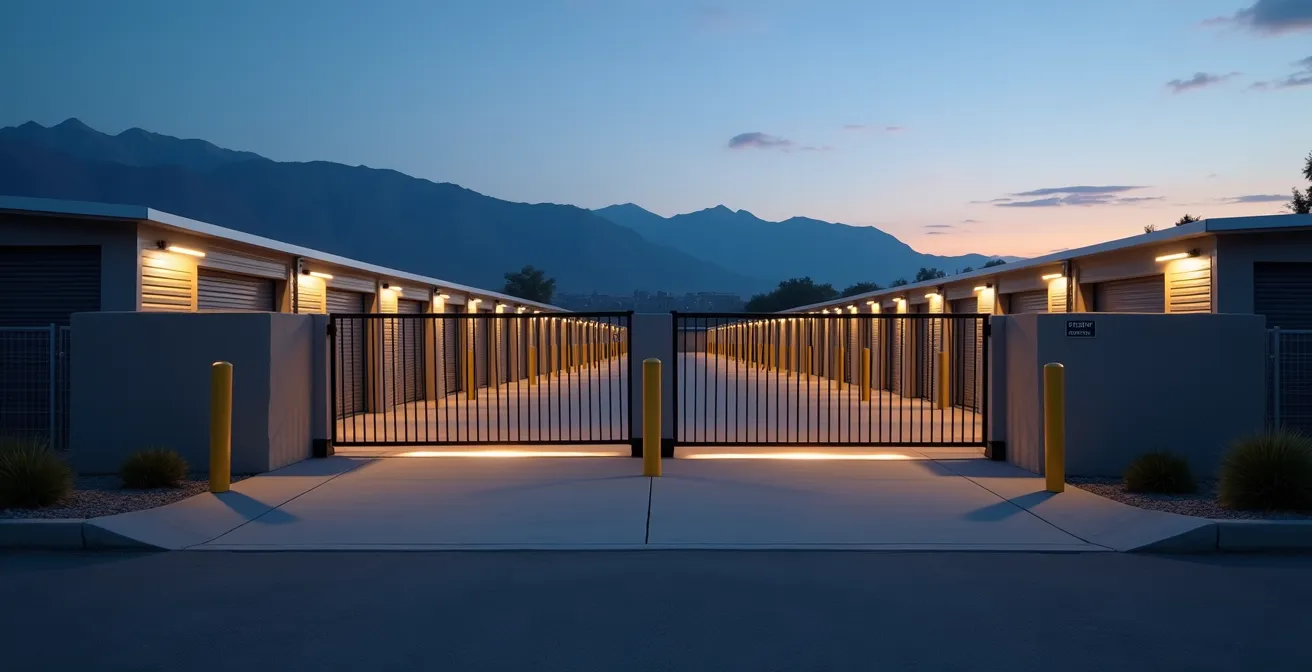
The customer journey is entirely self-service. A potential tenant rents a unit online, signs a digital lease, and receives a unique access code for the automated gate—all without speaking to a single employee. Monthly billing is handled automatically via recurring credit card payments, and the same software that manages billing also controls gate access, automatically locking out tenants who are late on payments. This closed-loop system drastically reduces delinquencies and eliminates the need for manual collections.
Case Study: Chris’s Automated Management System
Investor Chris, who self-manages his property, implemented an advanced software solution called Easy Storage. This platform automates the entire tenant lifecycle, from online rentals to automatic payments and even the sale of tenant insurance. His tenants appreciate the convenience of managing their accounts online 24/7, and Chris has a real-time dashboard of his entire operation without needing to be on-site, exemplifying a truly passive management style.
This level of automation is what makes the financial model so powerful. With significantly lower payroll, insurance, and administrative costs, a much larger portion of gross revenue flows directly to the bottom line. This lean operational structure is why many investors see 10% to 20% or more ROI in these facilities, far outpacing the returns of more management-intensive real estate assets. The technology transforms a piece of land into an automated cash-register.
When to Add More Units: Recognizing the 85% Occupancy Trigger for Expansion
The initial development of an RV storage facility is just phase one. The true path to exponential returns is through disciplined, data-driven expansion. The most successful operators don’t expand on a whim; they follow a clear set of operational triggers. The industry-standard benchmark is the 85% occupancy trigger. Once your facility consistently holds at or above this level, it’s a clear signal that demand in your market outstrips your current supply, and it’s time to initiate the next phase of construction.
Waiting until you are 100% full is a critical mistake. At that point, you are turning away paying customers and sending them to your future competitors. The 85% rule allows you to begin the expansion process—which can take months for permitting and construction—while still having inventory to lease. It ensures a continuous growth cycle without ever having to put up a “No Vacancy” sign. However, occupancy rate is just one metric. Sophisticated investors monitor several leading indicators to fine-tune their timing:
- Lease-Up Velocity: If the last 10% of your units filled up in less than 30 days, your market is red-hot, and you’re already behind schedule on expansion.
- Price Testing: Once you hit 75% occupancy, begin aggressively raising rates on new rentals. If the market absorbs these increases without a slowdown in leasing, it confirms deep demand.
- Waitlist Analysis: A growing waitlist is the most obvious sign, but the key is to analyze the data. Track which specific unit sizes or types are most requested to ensure you build what the market wants next.
- Competitive Monitoring: Keep a close watch on municipal building permits. If you see a competitor filing for a new facility, it’s a race to expand your existing, proven location before the market becomes saturated.
.
Financing this expansion is often easier than the initial loan, especially for a proven, cash-flowing asset. Lenders are more comfortable with an established business model. Furthermore, SBA loans are particularly favorable for this asset class, often requiring as little as a 10% down payment required for SBA loans, a significant advantage over the 30-35% typically required for conventional commercial loans. This allows operators to scale their profitable enterprise with less capital out of pocket.
Warehouses vs. Strip Malls: Why E-commerce Is Making One a Winner and the Other a Risk?
An astute investor must weigh the RV storage opportunity against other commercial real estate classes. Two of the most common are industrial warehouses and retail strip malls. The rise of e-commerce has created a clear divergence in the prospects of these assets. Strip malls, once a staple of real estate portfolios, face significant headwinds from online competition, leading to higher tenant turnover and declining cash flow stability. Warehouses, on the other hand, are thriving as essential “last-mile” hubs for e-commerce logistics.
RV and boat storage shares some characteristics with warehouses (simple structures, low maintenance) but possesses unique advantages over both. As Steve Hajewski, a veteran of the industry, explains, “the customers are long-term and loyal… They also tend to be extremely reliable in terms of paying rent, as they would never want to jeopardize their expensive toys.” This tenant profile is a world away from the precarious economics of a small retail business in a strip mall.
Compared to both warehouses and strip malls, the construction and maintenance overhead for an RV storage facility is significantly lower. In many cases, it’s simply graded land with gravel, fencing, and an automated gate. This lower capital expenditure requirement, combined with a stable, reliable tenant base, creates a uniquely resilient and profitable asset class that stands apart from its more traditional counterparts.
| Asset Type | Construction Cost | Maintenance | Tenant Risk | Cash Flow Stability |
|---|---|---|---|---|
| RV/Boat Storage | 50% of traditional self-storage overhead | Minimal – mostly land | Long-term, reliable tenants who pay on time | Very stable – recession resistant |
| Strip Malls | High – complex structures | High – multiple systems | High turnover, e-commerce competition | Declining – retail headwinds |
| Warehouses | Moderate – simple design | Low – basic structure | Corporate tenants | Growing – e-commerce boost |
Why Does Residential Real Estate Often Outperform Cash During High Inflation Periods?
During periods of high inflation, holding cash is a losing proposition as its purchasing power erodes. Hard assets like real estate are a classic hedge because their value and the income they generate can rise with inflation. Residential real estate is a popular choice, but it has a significant structural flaw in a rapidly rising inflationary environment: fixed-term leases. A landlord with tenants on 12-month leases can do nothing but watch as their own costs (taxes, insurance, maintenance) soar, while their revenue remains flat for up to a year.
This is where RV and boat storage demonstrates its superior agility as an inflation-fighting asset. The vast majority of storage rental agreements are month-to-month. This gives the facility owner the ultimate flexibility. If operating costs increase, rents can be adjusted across the entire facility with just 30 days’ notice. This allows revenue to track inflation in near real-time, protecting profit margins in a way that is impossible for a residential landlord locked into long-term leases.
Case Study: Self-Storage Performance During the 2008 Housing Crash
The resilience of the storage sector is not just theoretical. During economic downturns, such as the 2008 recession, self-storage facilities performed exceptionally well. As families downsized their homes to save money, they were faced with a choice: sell their possessions or store them. Many chose storage, leading to stable and even increasing demand for facilities during a period when most other real estate sectors were collapsing. This counter-cyclical nature provides a powerful layer of security for investors.
This ability to react instantly to changing economic conditions makes RV storage a more dynamic and arguably more effective inflation hedge than its residential counterpart. The landlord covers all repairs and utilities for a residential tenant; the RV storage owner’s primary cost is maintaining the land itself. This combination of low, predictable maintenance and highly flexible revenue is the core of its financial strength.
| Factor | RV Storage | Residential Real Estate |
|---|---|---|
| Lease Terms | Month-to-month flexibility | 12-month fixed leases |
| Rent Adjustment Speed | Can increase in 30 days | Wait up to 11 months |
| Maintenance Costs | Tenant maintains vehicle | Landlord covers repairs/utilities |
| Inflation Protection | Real-time adjustment capability | Delayed response to inflation |
Key Takeaways
- The primary driver of demand is structural and permanent: restrictive HOA rules in growing suburbs create a captive market of affluent vehicle owners.
- Profitability is unlocked through automation and tiered security, which minimize staff overhead and transform operational necessities into high-margin revenue streams.
- The 85% occupancy rate is the single most important operational trigger, signaling the precise moment to begin a profitable expansion before the market saturates.
How to Diversify Your Real Estate Portfolio Beyond Single-Family Homes for Better Yields?
For investors whose portfolios are heavily weighted in single-family homes, diversifying into a niche commercial asset like RV and boat storage can provide a powerful boost to both yield and stability. It offers an income stream that is not correlated with the residential rental market and carries a completely different risk profile. The management is less intensive, the tenants are more stable, and the income is more resilient to economic downturns. The growth of this market is undeniable, as reports show 11.2 million households own an RV in the US alone, a figure that has doubled in the last 20 years.
There are several strategic pathways to add this asset class to your portfolio, catering to different levels of capital and hands-on involvement. Each offers a way to tap into this lucrative market without the typical headaches of being a landlord.
- Passive Land Investment: At its core, RV storage is a business of monetizing land. For a truly passive approach, investors can purchase and entitle land, then lease it to an experienced operator, collecting ground rent with minimal involvement.
- Fractional Ownership via Syndication: For those who want direct equity without operational responsibility, syndications offer an ideal solution. Investors can place as little as $25,000-$50,000 into a professionally managed fund that acquires and develops large-scale facilities, receiving a share of the profits.
- Niche Specialization: Active investors can build a portfolio of smaller, highly-specialized facilities. One might cater exclusively to luxury Class A motorhomes with premium covered bays, while another focuses on serving fishermen with boat storage near a popular marina. This strategy allows an operator to dominate several high-margin sub-markets.
Ultimately, RV and boat storage provides a compelling answer to the question of how to achieve superior, risk-adjusted returns in real estate. It’s a data-driven, system-oriented business that rewards strategic planning and operational excellence far more than the often-unpredictable residential market.
For the entrepreneurial investor, the path is clear. The next logical step is to begin analyzing your local market, reviewing zoning maps, and identifying potential sites that fit the criteria for a high-yield RV and boat storage facility. The 12% return is not a distant dream; it’s the result of a well-executed plan.